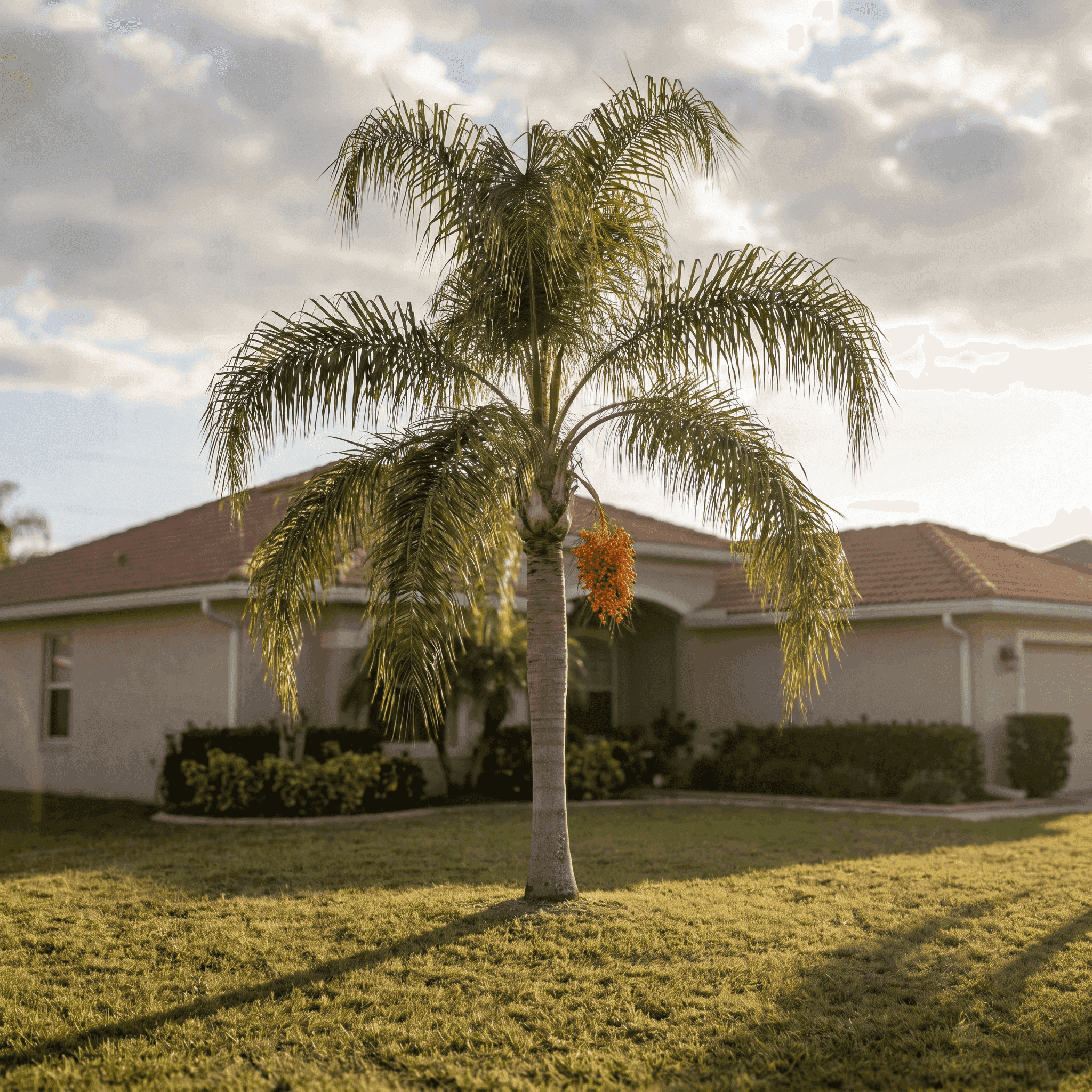
Why Your Neighbor's Queen Palm Will Hit Your Roof
Queen palms top the post-hurricane failure list in every major Florida storm. If your neighbor has one within fall-distance of your house, the math is uncomfortable. Here's how to have the conversation — and what the law says about who pays.
Most of the worst tree-on-roof calls we get in Southwest Florida after a major storm aren't from the owner of the tree — they're from the neighbor. The tree that came down belonged to the property next door. The damage is to the caller's roof. The conversation about who pays gets complicated fast.
Queen palms are disproportionately represented in those calls. They fall predictably in major storms. They fall in directions determined by lean and wind angle rather than property lines. And there are a lot of them in Southwest Florida — heavily planted in 2000s+ master-planned communities, often with no consideration of mature size or fall-zone.
The math
A typical residential queen palm matures at 40–50 feet tall, with the trunk diameter and root system that goes with that height. UF/IFAS post-hurricane species rankings consistently put queen palm at 2/5 for wind resistance — bottom tier, with reliable failure rates in any Cat 2+ event.
The fall radius is roughly equal to the height. A 45-foot queen palm planted 30 feet from your property line will, when it eventually falls in the wrong direction, reach 15 feet into your yard — well past your fence, well into your house's setback if you have a standard lot.
Who pays when it falls
Florida tree-fall liability law is essentially: it depends on whether the neighbor knew the tree was a hazard. If the queen palm was healthy and well-maintained and fell in a storm, that's generally an 'act of God' and your homeowner's insurance handles the damage. If the queen palm was visibly diseased, leaning, or otherwise demonstrably hazardous before the storm — and the neighbor had been notified of the hazard in writing — that shifts the liability calculus.
The practical implication: if you have a concerning tree on a neighboring property, the time to document it is now. A written notice from you to your neighbor identifying specific hazard concerns (with photos) is part of the foundation if the tree later falls and damages your property.
“If you have a concerning tree on a neighboring property, the time to document it is now — not after it's on your roof.”
The conversation to have
Neighbors generally don't appreciate being told their trees are a risk. But the conversation is worth having anyway, framed correctly:
- Lead with the species fact, not the opinion: 'I noticed you have a couple of queen palms near our property line. UF Extension publishes a wind-resistance ranking after every major storm, and queen palm is at the bottom of it — they fall consistently in hurricanes.'
- Acknowledge their decision: 'I'm not asking you to remove them — your trees, your decision. I just want to make sure you've seen the data.'
- State your position: 'If we have a major storm and one fell across the line, I'd want to make sure our insurance situations were both clear in advance. Are you carrying enough liability coverage for tree damage to a neighbor's property?'
- Document the exchange in writing afterward — even a friendly text message confirming the conversation matters legally later.
What you can do unilaterally
Florida law gives you the right to trim any portion of a neighboring tree that crosses your property line, at your own expense, up to the property line and no further. You cannot enter their property to trim. You cannot remove the trunk or root system on their side of the line. But you can hire a tree-service contractor to remove all of the canopy and branches that overhang your yard — a process that, for a tall queen palm, may significantly reduce its lean direction or wind-fall risk into your property.
We do this regularly on neighbor-line queen palms where the owner won't remove the tree. It's not a complete solution, but it's a defensible legal step and it materially reduces your roof's risk.
Frequently asked.
If my neighbor's tree falls on my house, whose insurance pays?
Usually yours — your homeowner's insurance covers damage to your structure regardless of whose tree caused it. Your insurance may then subrogate against the neighbor's insurance if there's evidence the neighbor knew the tree was hazardous and didn't address it. The practical result is: your premium probably goes up; the neighbor's liability coverage may or may not kick in depending on prior documentation.
Can I trim my neighbor's tree where it overhangs my property?
Yes, under Florida law you can trim portions of a neighboring tree that cross onto your property, at your own expense, up to the property line. You cannot enter their property or remove the trunk. We do this regularly on overhanging queen palms and other neighbor-line concerns.
What if my neighbor's tree is in obvious decline?
Document it. Photographs with date stamps, written notice to your neighbor identifying specific hazards (fungal conks, lean, decay signs), and ideally a credentialed arborist report establishing the tree as a hazard. If the tree later falls and damages your property, the documented prior notice is the basis for a liability claim against the neighbor — without it, you're essentially limited to your own insurance.
Got a specific tree you want to talk about?
Send a few photos and we'll come back with a real written quote — or just a second opinion.