Do You Need a Permit to Remove a Tree in Florida? Exemptions, Rules & Fees by Jurisdiction (2026)
Most Southwest Florida yard trees come out without a permit. FS 163.045 clears a hazardous tree anywhere in the state on a signed arborist report, and seven SWFL jurisdictions exempt ordinary single-family lots outright. Exemptions first, then the permit and the fee — every rule linked to the statute, county page, or application form it came from.
PUBLISHED May 12, 2026
Most residential tree removals in Southwest Florida need no permit. There is no statewide tree-removal permit in Florida and no state agency reviews an ordinary yard tree. One state statute — FS 163.045 — clears a hazardous tree in every jurisdiction in Florida on a signed arborist report. On top of that, seven of the 14 jurisdictions on this page exempt ordinary single-family lots outright.
Where a permit is required it is usually a routine filing with a small fee: $0 in Punta Gorda, $30 in the City of Sarasota, $65 on Longboat Key, $70 in Charlotte County, $144 in Manatee County. Tree permitting is a home-rule function — counties and cities write their own rules under Article VIII of the Florida Constitution and §§ 125.01 and 166.021, Florida Statutes — so the answer turns on which jurisdiction the parcel sits in.
Every threshold, fee, and code section on this page is linked in the Sources list at the end — the statute text itself, the county permit pages, and the actual application forms and brochures each jurisdiction publishes. Jurisdictions amend their tree codes (the City of Sarasota in November 2025, North Port in October 2024, Longboat Key in May 2026), so confirm anything you rely on with the reviewing department named for your jurisdiction before work starts.
The exemption that overrides all of this: FS 163.045
Section 163.045, Florida Statutes, is the most useful rule in the state for a homeowner with a hazardous tree. A local government may not require notice, an application, approval, a permit, a fee, mitigation, or replanting for the pruning, trimming, or removal of a tree on residential property when the owner possesses documentation from an ISA-certified arborist or a Florida-licensed landscape architect that the tree poses an unacceptable risk. It preempts the local ordinance, heritage-tree and grand-tree protections included.
In plain terms: there is a legal path to removing a hazardous tree with no permit anywhere in Florida, and it runs through a certified arborist's onsite assessment. Read the statute yourself — both the Florida Senate and Online Sunshine copies are linked in Sources below.
- Who signs it: an ISA-certified arborist or a Florida-licensed landscape architect. No other credential qualifies.
- What it is: an onsite assessment performed under the ISA Best Management Practices: Tree Risk Assessment, 2nd Edition (2017), signed.
- The standard: unacceptable risk — removal is the only practical means of reducing the risk below moderate under that BMP.
- Where it applies: residential property, meaning a single-family detached building on a lot actively used as a single-family residence, conforming or legal-nonconforming. Condominiums, townhomes, multifamily, HOA common area, and commercial parcels are outside the statute.
- No replanting or replacement tree may be required — § 163.045(2).
- You have to possess the documentation, not obtain it after the fact. The 2019 version said 'obtains'; the 2022 amendment changed it to 'possess'.
- Mangroves are the one exclusion — §§ 163.045(3) and (4) route them to the Mangrove Trimming and Preservation Act, FS 403.9321–.9333.
“Under FS 163.045 the signed onsite arborist assessment replaces the permit outright — no notice, no fee, no mitigation, no replanting.”
Southwest Florida jurisdictions already build the statute into their own paperwork. North Port codified it verbatim in the ULDC including the no-replanting provision. The City of Sarasota expressly recognizes it at §§ VII-310(f) and VII-320(d). Manatee County cites it as the reason certified-arborist dangerous-tree documentation cancels the 30-day street-tree replacement obligation. The City of Bradenton reprints the statute on the face of its own Tree Removal Permit Supplement, revised September 2025 — that PDF is linked in Sources below, so you can hand a city document back to the city.
The 2022 amendment, effective 7/1/2022, added the definitions above and raised the standard from 'danger' to 'unacceptable risk' tied to the ISA BMP. Net effect: the exemption is narrower than the 2019 original, and the signed assessment is the whole case.
The other paths to no permit
- Acreage and lot-size exemptions. Unincorporated Sarasota County exempts owner-occupied residential lots of 5 acres or less once the certificate of occupancy is issued (§ 54-585). Lee County exempts single-family lots of 5 acres or less (§ 14-377(a)(7)). Bonita Springs does the same (§ 7-230(a)(10)). Venice exempts single-family zoned lots of 1/2 acre or less. Longboat Key exempts improved single-family lots with an existing dwelling (§ 98.05(A)). Manatee County requires no permit for ordinary back-yard or side-yard removal. Cape Coral has no tree-removal permit provision for an existing single-family lot at all.
- Protected-list filters. Lee County regulates only species on the Appendix E protected list (§ 14-380(b)); Bonita Springs only the species listed at § 7-232 (§ 7-231(b)). Anything off the list comes out without a permit regardless of size.
- Dead trees. Exempt outright in Charlotte County. $0 permit fee in the City of Sarasota; no application fee in Bradenton with arborist documentation. Exempt in Lee County and Bonita Springs as dead or act-of-God hazard trees. Exempt in North Port on vacant property once verified.
- Invasive and exotic species. Charlotte County exempts FLEPPC Category I and Category II — the broadest invasive exemption in the region. Sarasota County exempts removal of exotic species under § 54-585; North Port exempts Category I. Manatee County requires no Tree Removal Permit for nuisance exotics. Longboat Key exempts 11 named nuisance exotics town-wide. Lee County and Bonita Springs never list exotics as protected in the first place. Fort Myers charges $0 when 100% of the removals are Category I.
- Trimming and pruning. Charlotte County requires no permit to trim or prune your own trees. Sarasota County states plainly that it does not require permits for trimming trees on private property — the exception is a Canopy Road Protection Zone or the right-of-way. Where the goal is clearance rather than the tree, pruning avoids the process entirely.
- Construction footprint. Charlotte County exempts trees within the building-construction footprint and within 6 ft of it, and puts projects of 1,000 sq ft or less outside the requirements.
- Declared emergencies. Sarasota County exempts storm debris during a declared emergency; the City of Sarasota suspends permit requirements during one (§ VII-315). North Port can suspend tree requirements for up to 90 days after a natural disaster. Longboat Key exempts trees killed or severely damaged by a natural disaster (§ 98.05(B)). Bonita Springs allows a 30-day suspension (§ 7-238). Lee County suspends the article outright (§ 14-378).
When a permit is required, what it costs
- City of Punta Gorda: no charge.
- City of Sarasota: $30 removal permit, plus $100 per Grand Tree and $5 per non-grand tree, plus a $5 per tree residential Urban Forestry surcharge. Prohibited, invasive, and dead trees are $0. The city publishes the form as the Tree Removal Permit Application — linked in Sources below.
- Town of Longboat Key: $65 adopted fee (Resolution 2025-15). Staff time is billed at $113 per hour.
- Charlotte County: $70 residential application ($80 commercial or multi-family), plus $1.00 per caliper inch, waivable through a Memorandum of Exemption. The county publishes the Tree Permit Application Package and a Single-Family Tree Permit Package — both linked in Sources below.
- Manatee County: $144 Tree Removal Permit, filed through Accela as application type A24. The county publishes step-by-step Tree Removal Permit Instructions — linked in Sources below.
- City of Bradenton: no application fee for dead or dying trees, trees damaging infrastructure, or utility-required removals, with arborist documentation (Resolution 19-09). The city's Tree Removal Permit Supplement is linked in Sources below.
- Sarasota County, Venice, North Port, Lee County, Fort Myers, and Bonita Springs set fees by current fee schedule rather than in the code text — amounts are not published online. Confirm with the reviewing office named in the county guides in this section.
Every SWFL jurisdiction — the exemption first, then the trigger
Fee amounts, full exemption lists, application forms, and penalty schedules for each of these are in the four county guides in this section: the Sarasota County guide, the Manatee County guide, the Charlotte County guide, and the Lee County guide.
- Sarasota County (unincorporated): exempt on owner-occupied residential lots of 5 acres or less after the CO, plus exotic species and declared-emergency storm debris (§ 54-585). No permit to trim trees on private property outside a Canopy Road Protection Zone or the right-of-way. Grand Trees and CRPZ trees still need a permit for removal.
- City of Sarasota: no lot-size exemption, but citrus, nursery stock, trees under 4.5 in DBH, and botanical gardens are exempt (§ VII-318), invasive and dead trees are $0, and an owner-occupant of 1 year or more may remove up to 25% of side-yard and back-yard canopy with no replacement, once every 3 years. Everything else at 4.5 in DBH or larger needs a permit.
- City of Venice: exempt on single-family zoned lots of 1/2 acre or less, except Heritage, Venetian, and Canopy Road trees. Sarasota County's Environmental Protection Division states it handles tree permitting for Venice as well as the unincorporated county.
- City of North Port: FS 163.045 is codified verbatim, and § 6.7.2 exempts prohibited species, FLEPPC Category I invasives, verified dead trees on vacant property, imminent-danger trees documented by an ISA risk assessment, nurseries, and government and utility work. Otherwise a tree removal authorization is required (ULDC § 6.7.1.B), and on developed property removal is approved for hazard, poor health, or a tree within 15 ft of an occupied structure or proposed addition.
- Manatee County (unincorporated): no permit for ordinary back-yard or side-yard residential removal, and none for nuisance exotics. A $144 Tree Removal Permit is required for HOA common area, commercial, conservation, wetland and landscape buffers, and easements.
- City of Bradenton: no application fee for dead, dying, infrastructure-damaging, or utility-required removals with arborist documentation, and the city reprints FS 163.045 on its own permit supplement. Otherwise contact Planning & Zoning at 941-932-9400 before removing any tree.
- Town of Longboat Key: exempt on improved single-family lots with an existing dwelling (§ 98.05(A)), on natural-disaster-killed trees (§ 98.05(B)), and on 11 named nuisance exotics town-wide (§ 98.08(A)). Vacant single-family, multi-family, and commercial parcels pay $65.
- Charlotte County: no permit to trim or prune your own trees, none for dead trees, none for FLEPPC Category I or II invasives taken by hand, none within 6 ft of a construction footprint, and none for projects of 1,000 sq ft or less. Removal of a tree 4 in or more in caliper (measured 12 in above grade) or a palm with 6 ft of clear trunk needs a $70 residential permit plus $1.00 per caliper inch.
- City of Punta Gorda: trees under 12 in DBH are outside the requirement, and the permit itself is free. At 12 in DBH or larger, a permit is required for any native or approved non-native tree (Ch. 26 Art. 12 § 12.14), approved on an arborist report showing hazard, death or terminal decline, or transmissible disease.
- Lee County (unincorporated): exempt on single-family lots of 5 acres or less (§ 14-377(a)(7)), on dead and act-of-God hazard trees, and on every species not on the Appendix E protected list (§ 14-380(b)). Coastal islands run on a separate rule — 5 trees per year off an improved single-family lot.
- City of Cape Coral: no separate tree-removal permit on an existing single-family lot. Regulation attaches at development and land clearing; heritage rules apply to Florida native canopy at 20 in caliper DBH.
- City of Fort Myers: the strictest trigger in Southwest Florida — a permit for the removal of all trees (§ 138-75), any tree 4 in DBH or larger (§ 138-101(a)), and mangroves of any size (§ 138-101(b)). The fee is $0 when 100% of the removals are FLEPPC Category I invasives.
- City of Bonita Springs: exempt on single-family lots of 5 acres or less (§ 7-230(a)(10)), on dead and act-of-God hazard trees, and on every species not listed at § 7-232 (§ 7-231(b)). Exotic removal needs no additional permitting (§ 7-226(c)).
- Village of Estero: removal of native species requires authorization from Community Development. Thresholds, exemptions, fees, and penalties are not published — call 239-221-5036.
Mangroves — the one carve-out FS 163.045 does not cover
Full treatment — heights, percentages, PMT rules, penalties — is in the Florida mangrove trimming law guide in this section. The FDEP mangrove FAQ and the statute text are linked in Sources below.
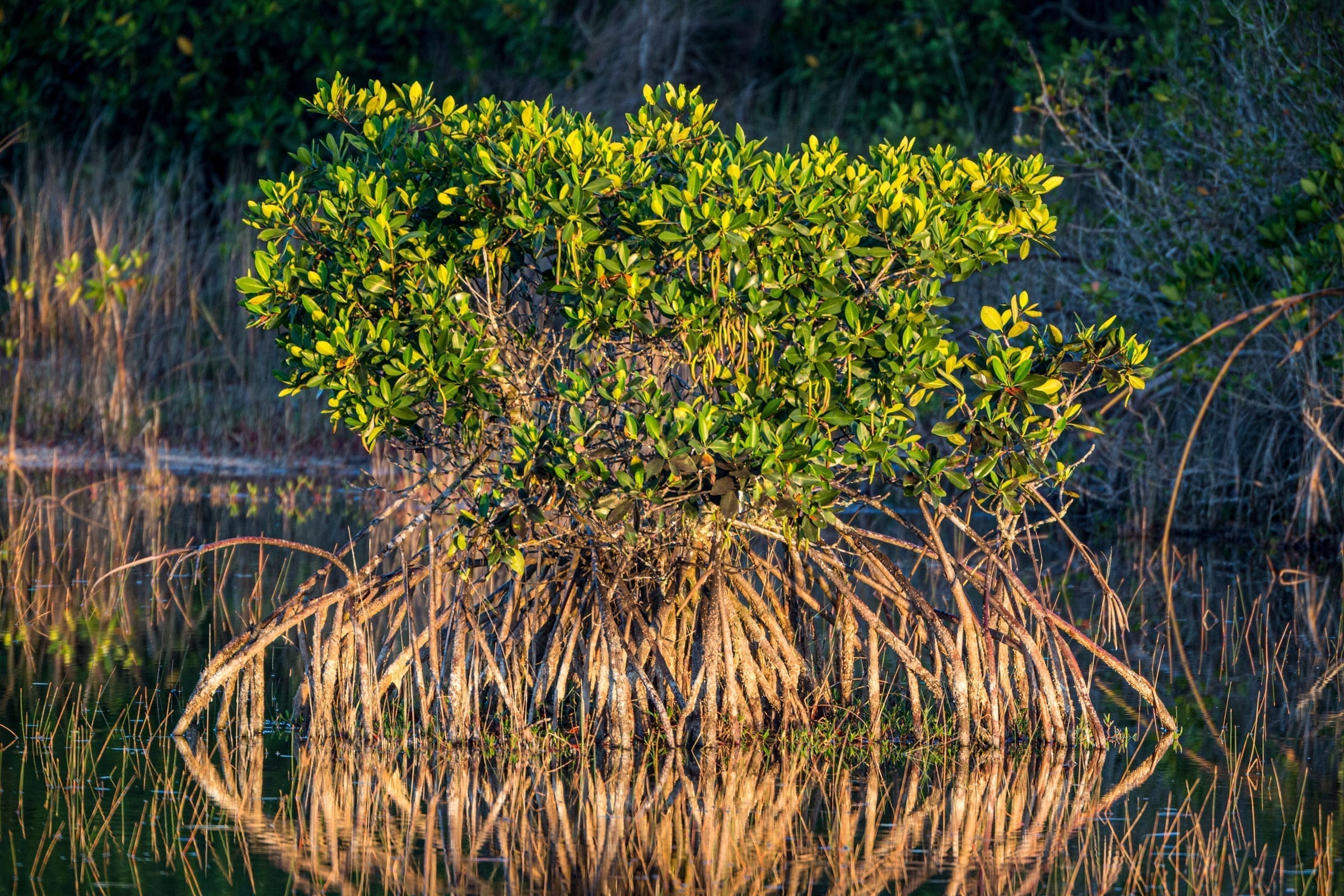
- Red, black, and white mangrove are governed statewide by the Mangrove Trimming and Preservation Act, FS 403.9321–.9333. A local tree code cannot override it, and FS 163.045 expressly does not apply.
- Trimming means cutting branches, twigs, limbs, or foliage. Removal, defoliation, and destruction are not trimming — they are never exempt and require an individual FDEP permit, usually with mitigation.
- Homeowner exemption (§ 403.9326(1)(a)) requires every condition: riparian mangrove fringe on land you own or control, pretrim height 10 ft or less, no cutting below 6 ft, no defoliation or herbicide, shoreline 150 ft or less. Past 150 ft of shoreline you may trim no more than 65% of the shoreline mangroves.
- Above 10 ft pretrim you need a Professional Mangrove Trimmer. Below 6 ft you need an individual permit. Outside the riparian mangrove fringe you need both.
- Sarasota County holds FDEP delegation (2016) — county permit plus PMT supervision under County Code Ch. 54 Art. XXXV. City of Sarasota requires the FDEP permit first, then the city permit. Fort Myers requires a city permit for a mangrove of any size. Longboat Key excludes mangroves from its tree code entirely, leaving FDEP direct.
Why the jurisdiction check happens before the saw
Penalties are per-inch or per-tree and nearly every jurisdiction treats each tree as a separate offense. Unincorporated Sarasota County assesses $200 per diameter inch on private trees and $500 per DBH inch on Grand Trees (§ 54-591). The City of Sarasota goes to $225 per DBH inch plus tripled permit fees plus mandatory replacement (§ VII-325). Charlotte County charges 4× the original fee for a first unauthorized removal, with code-board fines to $250 per day. Bradenton fines run up to $5,000.
The property owner carries it. Lee County § 14-375 makes owners who knew or should have known equally liable; City of Sarasota § VII-325 names owner and contractor separately. A contractor's mistake does not move the violation off your parcel — which is why the parcel's jurisdiction gets checked before a price is quoted.
Permit questions get flagged during the estimate. A photo bid costs nothing. Where a permit is required, the application is the owner's; the guides in this section name the reviewing office, the phone number, and the actual form for each jurisdiction.
Frequently asked.
Can I remove a tree without a permit if it's dangerous?
Yes, anywhere in Florida, under FS 163.045 — if you possess signed documentation from an ISA-certified arborist or a Florida-licensed landscape architect, based on an onsite assessment under the ISA Best Management Practices: Tree Risk Assessment, 2nd Edition (2017), stating that removal is the only practical means of reducing the risk below moderate. The parcel must be a detached single-family building actively used as a single-family residence; condos, townhomes, HOA common area, and commercial are excluded. When it applies, the local government cannot require notice, a permit, a fee, mitigation, or replanting — heritage and grand-tree protections included. It does not apply to mangroves. A tree that could be pruned back to moderate risk does not meet the standard.
Is there a statewide tree removal permit in Florida?
No. Tree permitting is a home-rule function under Article VIII of the Florida Constitution and §§ 125.01 and 166.021, Florida Statutes. Every county and city writes its own trigger, thresholds, exemptions, fee, and penalty — and most of them exempt ordinary single-family lots. The only statewide overrides are FS 163.045, which clears a hazardous tree on detached single-family residential property, and the Mangrove Trimming and Preservation Act at FS 403.9321–.9333.
Which SWFL jurisdictions let me remove a backyard tree with no permit at all?
Unincorporated Sarasota County (owner-occupied lots of 5 acres or less after the CO), unincorporated Manatee County (ordinary back and side yard), unincorporated Lee County and Bonita Springs (single-family lots of 5 acres or less, plus a protected-species-list filter), Venice (single-family zoned lots of 1/2 acre or less), Longboat Key (improved single-family lots with an existing dwelling), and Cape Coral (no permit provision for an existing single-family lot). Charlotte County, the City of Sarasota, North Port, Fort Myers, Punta Gorda, and Bradenton require a permit on an ordinary house lot — each with its own exemption list, and all of them subject to FS 163.045.
Do I need a permit just to trim a tree?
Usually not, with real exceptions. Charlotte County requires no permit to trim or prune your own trees. Sarasota County states on its own environmental permitting page that it does not require permits for trimming trees on private property — the exceptions are the Canopy Road Protection Zone and the right-of-way. Venice requires a pruning permit for any branch 10 in or larger in diameter measured 12 in from the union on Heritage and Venetian trees, and any branch 2 in or larger inside a Canopy Road Protection Zone with certified-arborist supervision. Mangroves are the outlier — trimming is regulated statewide by height and percentage under the Mangrove Act no matter which city you are in.
Are oak trees protected in Florida?
Not by state law, and FS 163.045 overrides local oak protections for a documented hazardous tree on a detached single-family lot. Otherwise oaks are protected where a local code protects them, and the threshold varies. The City of Sarasota classes Live Oak and Sand Live Oak at 24 in DBH or larger as grand trees. Charlotte County prohibits removal of Oak, Cypress, and Pine at 30 in DBH or larger as heritage trees. Fort Myers and Cape Coral use 20 in DBH for heritage natives. North Port scores Live Oak and Sand Live Oak at 80 points, and Sarasota County uses a 100-point species threshold for Live Oak. Lee County and Bonita Springs regulate oaks only because they appear on a protected-species list — and both exempt single-family lots of 5 acres or less.
What happens if I remove a tree without a permit?
Penalties are per-inch or per-tree, and nearly every jurisdiction treats each tree as a separate offense. Unincorporated Sarasota County assesses $200 per diameter inch on private trees and $500 per DBH inch on Grand Trees (§ 54-591). The City of Sarasota goes to $225 per DBH inch plus tripled permit fees plus mandatory replacement, and $100 per day for a continuing violation (§ VII-325). Charlotte County charges 4× the original fee for a first unauthorized removal, with code-board fines to $250 per day. Bradenton fines run up to $5,000. Lee County, Fort Myers, Bonita Springs, and Longboat Key each cap at $500 per violation, with Fort Myers and Bonita Springs also carrying up to 60 days as a criminal matter, and Bonita Springs adding 3-for-1 restoration monitored for 5 years.
Does HOA approval replace the city or county permit?
No. Architectural review and the jurisdiction's permit are separate processes and neither one waives the other. The reverse also matters: FS 163.045 does not apply to HOA common area or to attached housing, so the hazardous-tree exemption that covers a detached single-family lot does not cover the association's trees. In Manatee County the split is explicit — no permit for your own back yard, but a Tree Removal Permit is required for HOA common areas.
Got a question on your specific tree?
Articles are useful, but a real photo bid gets you a species-specific answer for your property in writing.
Sources.
Every threshold, fee, and code section on this page traces to a primary source below. Ordinances change — click through and confirm with the jurisdiction before relying on any of it.
- § 163.045, Fla. Stat. — Tree pruning, trimming, or removal on residential property (Florida Senate, 2025)
- § 163.045, Fla. Stat. — full text (Online Sunshine, The Florida Legislature)
- § 125.01, Fla. Stat. — Powers and duties of county governing bodies (county home rule)
- § 166.021, Fla. Stat. — Municipal home rule powers
- Ch. 403, Part VII, Fla. Stat. — Mangrove Trimming and Preservation Act, §§ 403.9321–403.9333
- § 403.9326, Fla. Stat. — Mangrove trimming exemptions (homeowner exemption)
- Florida DEP — Mangrove Trimming Frequently Asked Questions
- Sarasota County — Environmental Permitting and Projects (trimming statement, § 54-586(2) approval conditions, approved planting list)
- Charlotte County — Residential Tree Permit page ($70 residential / $80 commercial)
- Charlotte County — Tree Permit Application Package (PDF)
- Manatee County — Tree Removal Permit Instructions (PDF)
- City of Bradenton — Tree Removal Permit Supplement, rev. September 2025 (reprints FS 163.045 in full)
- City of Sarasota — Tree Removal Permit Application (PDF)
- City of North Port — Tree Removal & Arborist Services
- Lee County — Department of Community Development (Vegetation Removal Permit)