Florida's Mangrove Trimming Law (the MTPA Explained)
When you can trim, when you can't, and the difference between MTPA-certified work and unlicensed cutting.
PUBLISHED May 12, 2026
Florida's mangroves are protected under the Mangrove Trimming and Preservation Act (MTPA), a state statute that regulates who can trim mangroves, how much, and under what circumstances. Most Southwest Florida property owners with a mangrove on their lot do not realize the rules apply to them — until a code-enforcement notice arrives, or a neighbor complains.
This guide walks through the practical version of the law: what MTPA actually says, what triggers a permit, who can do the work, what counts as protected mangrove, and what the typical violation case looks like. We're not lawyers and this is not legal advice; for any specific situation, talk to a licensed Florida environmental attorney or a Mangrove Trimming Professional certified by the state.
What MTPA is, in one paragraph
The Mangrove Trimming and Preservation Act (Section 403.9321 to 403.9333, Florida Statutes) was enacted in 1996 and gives the Florida Department of Environmental Protection authority over mangrove trimming statewide, with delegation to certain local governments. The intent is to preserve mangrove ecosystems while allowing property owners limited ability to maintain views and access. The basic move is that mangroves cannot be trimmed below specified height limits, cannot be removed without authorization, and certain trimming operations require a Mangrove Trimming Professional (MTP) to perform or supervise.
What counts as a mangrove
Three species are protected as 'mangrove' under MTPA, plus a fourth associate species sometimes included in local interpretations:
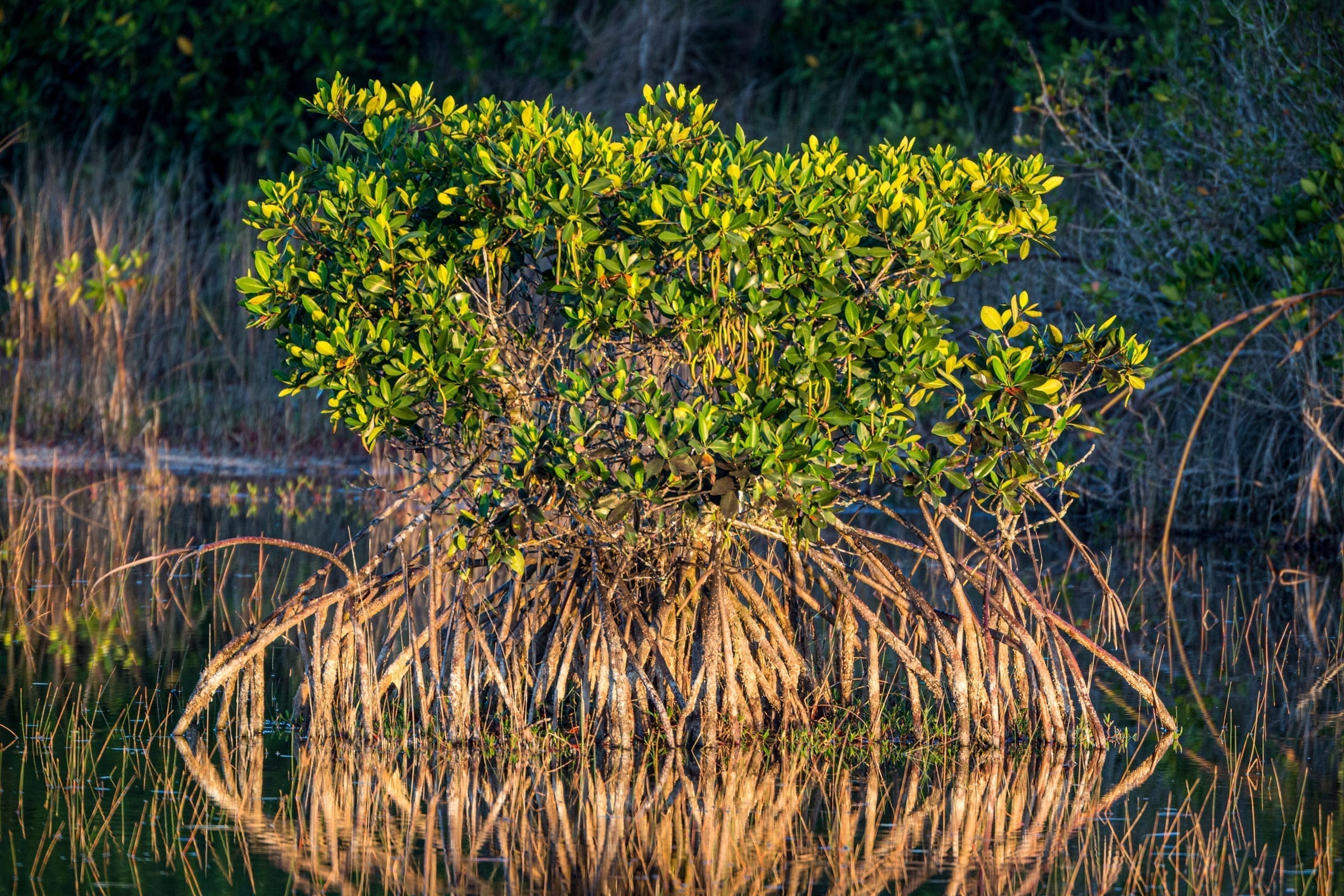
- Red mangrove (Rhizophora mangle) — distinctive arching prop roots, smooth gray bark, glossy elliptical leaves. Grows in the wettest zone, often standing in tidal water.
- Black mangrove (Avicennia germinans) — distinctive pneumatophores (pencil-like vertical roots sticking up from the mud), salt-crystallized whitish underside on the leaves. Grows in the middle tidal zone.
- White mangrove (Laguncularia racemosa) — smaller rounded yellowish-green leaves with two small reddish salt glands at the petiole base. Grows at the inland upper edge of the mangrove fringe.
- Buttonwood (Conocarpus erectus) — technically a mangrove associate, not always covered by MTPA depending on local interpretation. Often grows just upland of true mangroves.
What requires a permit (or an MTP)
The summary version, accurate enough for a starting point but not exhaustive — actual rules vary by mangrove height, prior trimming history, and local-government delegation:
- Mangroves taller than 24 feet: trimming generally requires DEP authorization or an MTP, depending on situation and local government.
- Mangroves taller than 10 feet on most residential parcels: trimming for view or access without an MTP is generally limited, with specific height/percentage rules.
- Mangroves between 6 and 10 feet: trimming is often allowed by property owners with limits — typically no more than the prior trim height, no removal of more than the canopy regrowth, and never trimming below the prior trim line.
- Mangroves under 6 feet: generally more permissive, but local rules vary.
- Any cut that crosses a property line or affects state-owned submerged lands: separate state authorization required.
- Removal of any mangrove for clearing or construction: nearly always requires DEP authorization, often with mitigation requirements.
Who can legally trim mangroves
Property owners can do limited trimming themselves on their own land, within the height and percentage limits described above. For anything beyond those limits — taller mangroves, larger reductions, view-clearing work — the trimming must be performed by or under the supervision of a state-certified Mangrove Trimming Professional (MTP).
An MTP certification is a real, verifiable Florida credential. The professional has demonstrated knowledge of mangrove biology, MTPA, and the practical limits of compliant trimming. Their certification number is publicly verifiable. Hiring someone who simply has a chainsaw and a truck to trim mangroves — even at heights that might be technically allowed — exposes you, as the property owner, to potential MTPA enforcement action.
“Hiring an uncertified trimmer for an MTP-required job puts the violation on you, not them.”
What violations look like — and what they cost
MTPA enforcement actions are real and ongoing. The Florida DEP and delegated local governments investigate complaints, issue notices of violation, and assess civil penalties. Common cases:
- Property owner trims 'just a little' off a 20-foot mangrove for a water view; neighbor reports it; enforcement determines the trim crossed the height threshold; civil penalty plus mitigation requirements.
- Contractor (without MTP) trims mangroves on multiple properties; one homeowner complaint triggers investigation across all the properties; multiple enforcement actions.
- Construction project clears mangroves without authorization; project halted, civil penalty, mitigation requirement to replant elsewhere in approved ratios.
Penalties scale with severity and history but routinely run into the thousands per affected mangrove, plus mitigation costs that can multiply that. The math doesn't favor 'we'll just do it and see what happens.'
Local additions
Counties and municipalities with delegated MTPA authority sometimes have additional rules. Notable Southwest Florida examples:
- Sanibel: among the strictest local interpretations in the state. Native species protections are layered on top of MTPA.
- Sarasota County and the City of Sarasota: delegated authority, with their own permit process and inspection requirements.
- Lee County: delegated authority; Sanibel and Fort Myers Beach have additional rules.
- Charlotte County: delegated authority; Punta Gorda has its own tree ordinance that interacts with MTPA on protected species.
Practical advice for property owners
- If you have mangroves and you want to do anything beyond cosmetic touch-up under 6 feet, get a professional involved first. The cost of a consult is a tiny fraction of an MTPA penalty.
- Document the current state of your mangroves with dated photos. If a future trim raises a question, prior documentation helps.
- If a tree-service contractor offers to trim your mangroves and they're not an MTP (or working under one), find a different contractor. The violation falls on the property owner.
- If a named storm damages your mangroves, document the damage immediately and contact DEP or your delegated local authority before doing any cleanup work that goes beyond removing debris.
Frequently asked.
Can I trim my own mangroves?
Yes, within specific MTPA limits — generally for mangroves under 10 feet tall, and only within strict percentage and height-reduction rules. Anything beyond those limits (taller mangroves, larger reductions, view-clearing) requires a state-certified Mangrove Trimming Professional (MTP). When in doubt, get a consult before you cut — MTPA penalties run into the thousands per tree.
Are buttonwoods protected too?
Buttonwood (Conocarpus erectus) is technically a mangrove associate, not a true mangrove. Whether it falls under MTPA protections depends on local-government interpretation and where it's growing. Sanibel and some other strict-rule jurisdictions treat it as protected; some other counties do not. Assume protection until you've verified otherwise for your specific parcel.
What if a hurricane damages my mangroves — can I clean up?
Removing storm debris from around your mangroves is generally allowed. Cutting or removing damaged mangroves themselves still falls under MTPA — even when the damage is real and the tree is dying. Document the damage, contact DEP or your delegated local authority before significant cleanup, and get an MTP involved if any actual cutting needs to happen.
How do I verify an MTP certification?
The Florida DEP maintains a list of certified Mangrove Trimming Professionals; ask any contractor for their MTP number and verify it. If a contractor can't or won't produce the credential, they're not legally permitted to perform MTP-required work — and hiring them puts the MTPA violation on you, not them.
Got a question on your specific tree?
Articles are useful, but a real photo bid gets you a species-specific answer for your property in writing.