Post-Storm Tree Triage: What to Save, What to Cut
Reading damage 48 hours out — bark separation, root plate lift, leader breakage.
PUBLISHED May 12, 2026
The most dangerous tree on your property after a hurricane is often not the one that fell — it's the one that's leaning a few degrees more than it was last week. Or the one with a hidden split through the main crotch. Or the oak whose root plate lifted four inches during the storm and settled back down before anyone noticed.
Post-storm tree triage is the practice of reading these signals fast enough to make smart decisions before the next storm — or before something fails on its own. Here's the framework we use after every named-storm event in Southwest Florida.
The first 48 hours mindset
Within hours of a storm passing, do a slow walk of your property — but don't touch anything yet. The goal is observation, not cleanup. Cleanup can wait a day. Documentation cannot.
Take photos of every tree, especially the ones that look damaged. Take photos of things that look fine too — sometimes a tree that looks intact has lifted at the root plate or developed a split you'll only notice on comparison with the pre-storm reference.
Active emergencies first
Some situations are emergencies and need a tree professional now, not after the cleanup line:
- Tree on a structure (roof, vehicle, pool cage, fence) — secondary damage compounds every hour the load stays in place.
- Tree blocking access (driveway, road, fire-truck egress) — clearance is the first job.
- Tree leaning over a structure with a fresh tilt or audible cracking — imminent failure risk.
- Hanging limb over a walkway, doorway, or active area — pedestrian risk.
- Tree on or near a downed power line — STAY AWAY, assume the line is live, call the utility first.
Damage you can usually save
- Partial branch breakage where the broken branch can be cleanly pruned back to the next healthy lateral or to the trunk.
- Deadwood and small limb loss in an otherwise intact canopy — clean it up, the tree will be fine.
- Defoliation — leaves stripped by wind. Most healthy trees re-foliate within 4–8 weeks, no intervention needed.
- Sabal palm that lost some fronds — palms re-grow fronds on their own schedule. Don't replace with hurricane-cutting.
- Single major limb loss on a mature shade tree — usually survivable with proper cleanup, though crown asymmetry may be permanent.
Damage that usually means removal
- Trunk split through the main crotch — the structural failure can't be repaired, and the tree is now a hazard.
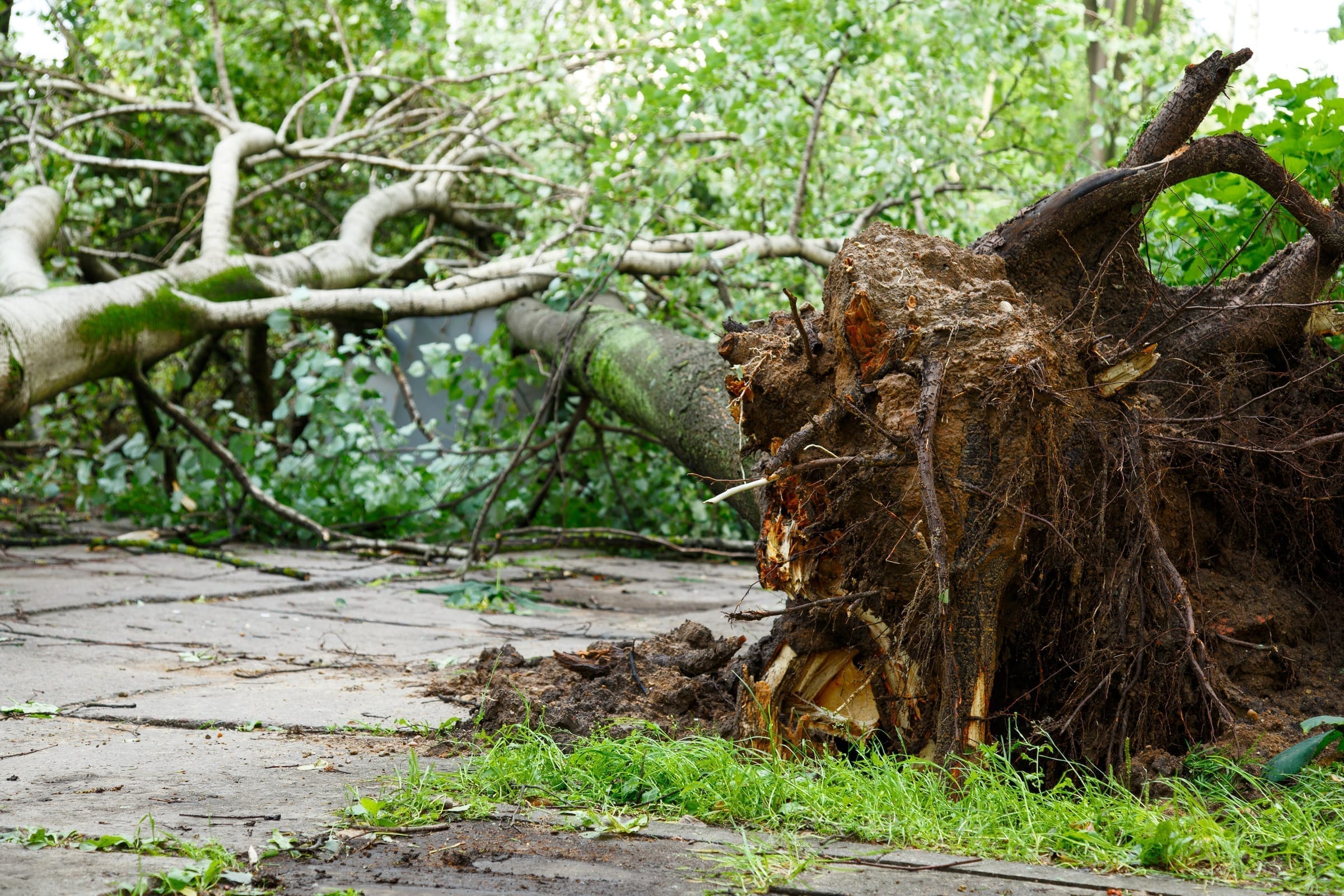
- Root plate lift — if the tree has visibly tilted at the base and you can see the soil rising on one side, the root system has been compromised. Even if the tree looks upright, it's structurally unsound.
- More than 50% of the live canopy lost in the storm — the tree's recovery odds drop sharply past this threshold.
- Bark stripped over more than a third of the trunk circumference — phloem damage that severe is rarely survivable.
- Catastrophic crown failure on a pine — pines are particularly poor at recovering from top loss.
The hidden-damage timeline
Trees that survived the visible part of the storm can fail months or years later from damage that wasn't obvious. Watch for: progressive lean (compare against a fixed point — fence line, building corner — every few weeks); slow canopy decline (sparser foliage each year); seasonal die-back working from the canopy edge toward the trunk; fungal conks appearing at the base.
Annual structural pruning and proactive hazard assessment for the 3-to-5 years following a major storm is the right baseline. It costs less than the emergency removal you avoid.
Documenting for insurance
Time-stamped photos from before any cleanup begins are the single most useful thing you can do for an insurance claim. Photograph: the damaged tree from multiple angles, the structure it damaged (if any), the surrounding context. Keep the originals — adjusters sometimes ask for raw files with metadata intact.
Itemized scope-of-work and cost breakdown from your tree-service contractor is the other half of the package. Adjusters are looking for a clear description of what was removed, what was preserved, and the cost basis. We provide this format automatically with any storm-response job.
Frequently asked.
My tree is leaning slightly after the storm — should I worry?
Yes, and it's worth a professional look. A tree that's leaning more than it was before the storm has almost certainly suffered some root-plate compromise. Even if the new lean is mild, the next storm will likely take it further. We can usually assess from photos and tell you whether it's a watch-list tree or a removal call.
How fast does insurance want photos?
ASAP — ideally before any cleanup. Many policies require photo documentation of damage in its original state to honor claims at full value. If you've already started cleanup, photograph what's left and any debris piles before they're hauled. We provide insurance-format documentation as part of any storm-response job.
When should I take pre-storm photos?
Annually, before June. A 5-minute walk-around with your phone, photographing every significant tree from the same angles each year, builds a baseline that's invaluable for post-storm comparison and for insurance. It costs nothing and can save thousands.
Got a question on your specific tree?
Articles are useful, but a real photo bid gets you a species-specific answer for your property in writing.