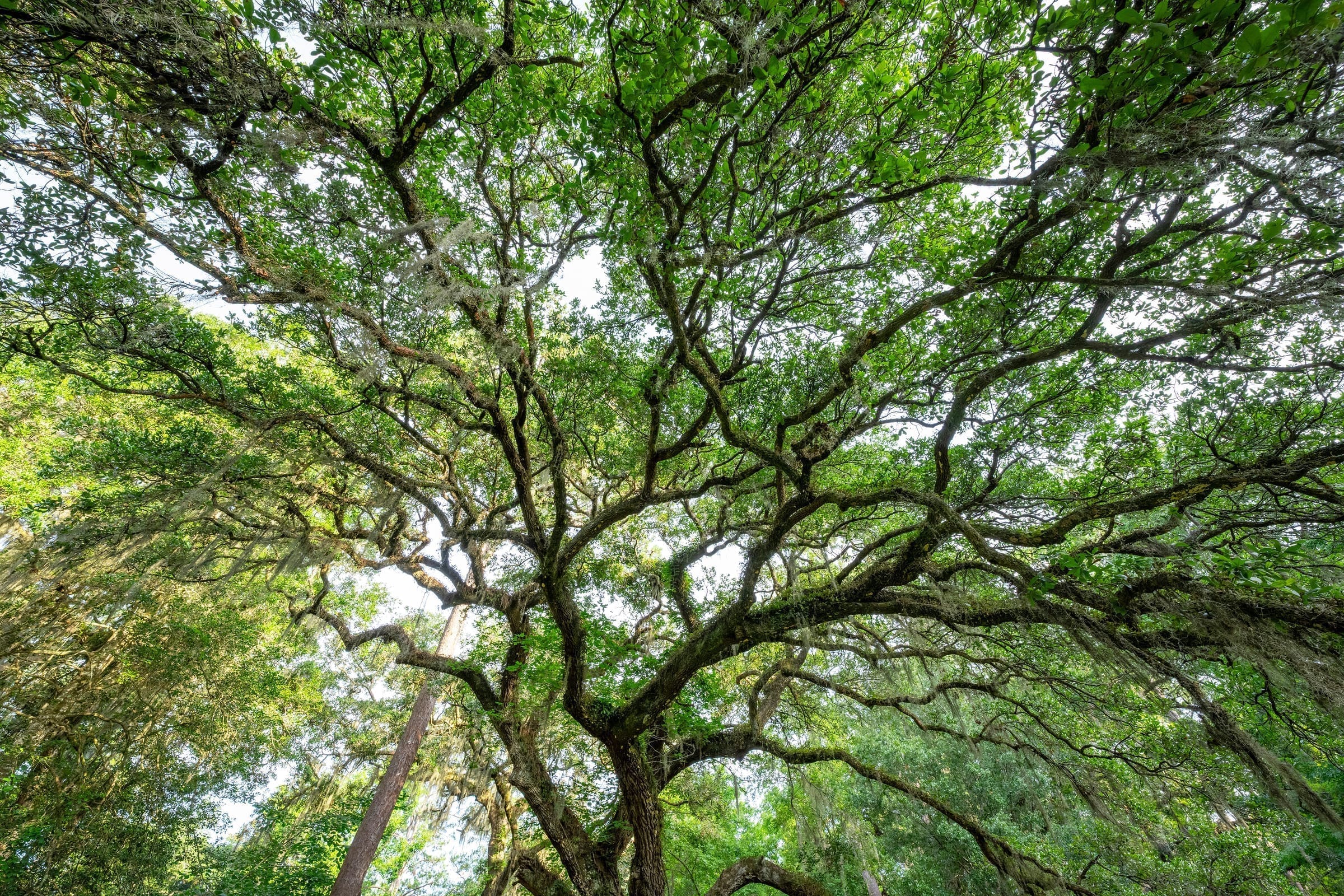
How to Identify Florida Trees
Bark, leaf shape, fruit, growth pattern — the key features for the most common SWFL species.
PUBLISHED May 12, 2026
Most homeowners can't reliably tell a live oak from a laurel oak, or a sabal palm from a queen palm. That's not a criticism — there's no reason most people would learn the difference. But the difference matters: a live oak is a 100-year asset, a laurel oak is a 40-year hazard candidate; a sabal palm is hurricane-tough, a queen palm is the first thing to fall.
Here's a quick-reference guide to identifying the 10 most common Southwest Florida tree species, with the diagnostic features that actually work.
What to check, in order
- Form & habit — overall shape, multi-trunk vs. single, spreading vs. upright.
- Leaf — shape, size, arrangement (opposite vs. alternate), edge (smooth vs. toothed vs. lobed).
- Bark — color, texture, fissures, peeling pattern.
- Fruit / cone / seed pod — present in season, often the clearest ID feature.
- Habitat — wet vs. dry, coastal vs. inland, native habitat vs. planted.
Common confusions, resolved
Live oak vs. laurel oak: live oak (Quercus virginiana) has small leathery oblong evergreen leaves with pale undersides; laurel oak (Quercus laurifolia) has narrow willow-like semi-evergreen leaves. Live oak spreads wide and low; laurel oak grows tall and upright. Live oak almost always carries Spanish moss on horizontal limbs; laurel oak rarely does.
Sabal palm vs. Washingtonia: both are fan palms, but sabal has costapalmate fronds (the rachis arches into the leaf, giving a curved midrib) while Washingtonia has flat-fan fronds with no extended midrib. Sabal trunk has the iconic criss-cross 'boot' pattern; Washingtonia trunks are smoother or have a 'pineapple skirt' of dead petioles.
Sabal palm vs. queen palm: sabal has fan-shaped fronds; queen has feathery pinnate fronds. Completely different leaf structures, no overlap.
Brazilian pepper vs. native sumac: Brazilian pepper has a winged stem between the leaflets; native sumacs don't. Brazilian pepper berries are dense terminal clusters of bright red; native sumac berries are also red but in different cluster patterns.
Top 10 SW Florida species — diagnostic at a glance
- Live oak — small leathery evergreen leaves, gnarled gray bark, Spanish moss, broad horizontal spread.
- Laurel oak — narrow willow-shape leaves, tall upright form, smooth bark transitioning to vertical furrows.
- Sabal palm — fan fronds with arched midrib, criss-cross boot pattern on trunk, native, hurricane-tough.
- Royal palm — smooth concrete-gray trunk, bright green bulging crownshaft, pinnate fronds, tall majestic.
- Queen palm — slender ringed tan trunk, gracefully arching feathery pinnate fronds, orange fruit clusters.
- Slash pine — long needles in bundles of 2–3, plated reddish-brown bark, tall straight trunk, high crown.
- Bald cypress — feathery deciduous needles in flat sprays, reddish-brown fibrous bark, buttressed trunk in wet sites.
- Southern magnolia — large glossy dark green leaves with rusty undersides, large white saucer flowers, pyramidal evergreen.
- Gumbo limbo — coppery-red peeling papery bark ('tourist tree'), pinnate leaves, spreading rounded crown.
- Sea grape — large round leathery leaves with prominent red veins, multi-trunked coastal habit.
Frequently asked.
What's the easiest way to identify a tree from a photo?
Photograph the leaf (close-up showing edge detail and underside), the bark (close-up of texture), the form (full tree from a distance), and any fruit or flowers in season. Send the four photos and we'll usually ID it — there's no charge for a species identification.
Is there an app that identifies Florida trees?
Several work reasonably well for common species — iNaturalist and PictureThis are the most accurate in our testing. They struggle with closely-related species (laurel oak vs. live oak, sabal palm vs. similar palms) and with anything outside the common cultivated set. For high-stakes ID (heritage tree designations, removal permits), a human professional ID is more reliable.
How do I tell if a tree is native to Florida?
The Florida Native Plant Society maintains an authoritative database. Common natives in SW Florida include live oak, sabal palm, slash pine, bald cypress, southern magnolia, gumbo limbo, sea grape, and the three mangrove species. Common non-natives include queen palm, Washingtonia, royal palm (technically native to extreme southern FL only), and most ornamental flowering trees.
Got a question on your specific tree?
Articles are useful, but a real photo bid gets you a species-specific answer for your property in writing.